Dulcínia Paiva shared with us the memories of someone who, although she never worked at the Rovisco Pais Colony Hospital (HCRP), maintained a strong connection to the institution. Her father, her husband, and her godfather all worked at the HCRP. The family home and the small shop they owned in Tocha were meeting places for HCRP staff, with whom Dulcínia socialized from a very young age.
With the sharing of these memories came a sense of longing. Mrs Dulcínia spoke of her father, Antero Inácio, with great emotion and told us: “He was very modest, but for me he was a great reference. I was always very proud of my father!”
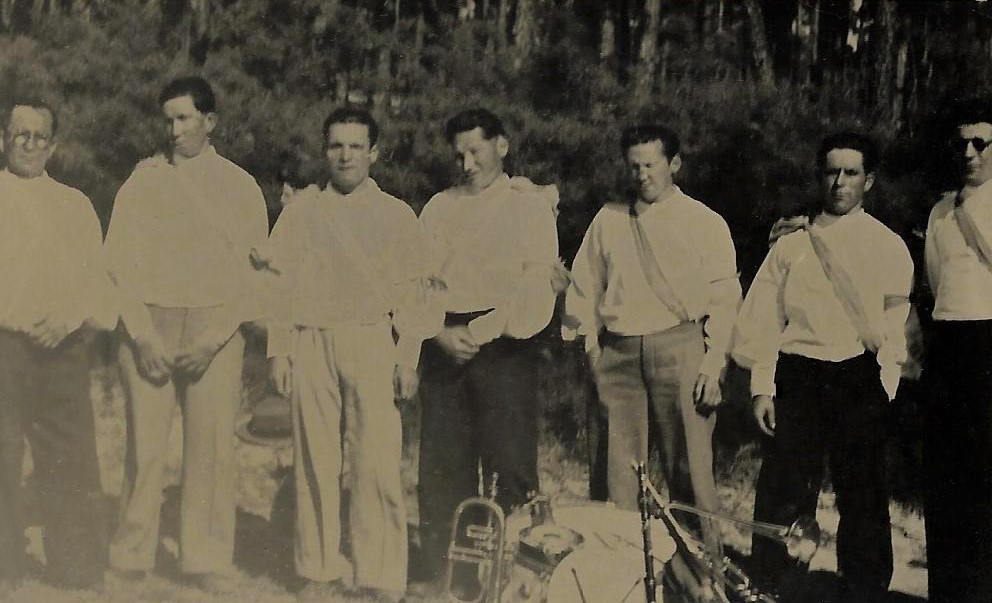
Mr Antero Inácio was from Tocha and had studied at the Industrial and Commercial School of Porto. He was a self-taught photographer and wrote many verses, “some for the Rancho of Tocha.” His collaboration with the HCRP coincided with the period when Dr Manuel dos Santos Silva was director of the Hospital (between 1947 and 1952). “He was responsible for photographing newly admitted patients and for producing a photographic record of lesions as patients underwent treatment, in order to document the clinical evolution of the disease.” Dulcínia recalls two cases that particularly impressed her father and that he later told her about: “a man who had many lepromas on his face and who, after treatment, improved greatly,” and “a young woman who, because of the disease, had lost all her hair and asked my father to photograph her in a more secluded place.” These images were later “reproduced as slides by my father and shown at courses and congresses on leprology.”
Alongside this work, Mr Antero Inácio collaborated in revising the scientific articles produced by Dr Manuel dos Santos Silva—“adding commas, correcting a missing ‘que’…”. And when he took part in the Brigades, “he dealt with the writing.” From those times, Mrs Dulcínia recalled the social gatherings held at her father’s home, where doctors, nurses, and other HCRP staff would meet, and how “at Carnival they would all dress up and go around frightening people.” Sometimes the Mother Superior, Sister Azinhais, would also attend—“she was a tall, very distinguished lady, with exemplary posture.” She showed us some photographs taken by her father. “He died young, at 59 years of age,” in 1961, but Dulcínia still remembers some of the words from the tribute written in his honor and what was published in the newspaper Boa Nova on the day of his funeral (15 September 1961): “He collaborated with the fledgling administration of the Rovisco Pais Colony Hospital at a time when there was nothing beyond the buildings themselves. How he knew how to create affection in every patient! How he knew how to leave that place! What refinement! What diplomacy!”
Dulcínia met her husband at the Hospital. He was older, and her parents were not very favorable to the union for that very reason. Nevertheless, they married in 1961 at the Sé Nova Cathedral in Coimbra. She was accompanied by her godfather, Dr Manuel dos Santos Silva. He and her godmother were major references in her life. Her godmother was a nurse before marrying and, together with Nurse Ana Isabel Magalhães, assisted her during the birth of one of Dulcínia’s children.
Her husband, António Ferreira Paiva, was a nurse and trained at the Dr Ângelo da Fonseca School of Nursing in Coimbra. Before working in Tocha, while still single, he had already worked in Buarcos and at the Coimbra University Hospitals. He began working at the HCRP in 1956, and Mrs Dulcínia recalls him saying that he had still worked with Professor Bissaya Barreto when he came to operate, and that he would tell him: “Paiva, I want everything perfectly sterilized (…)!”
A few years after their marriage, he was assigned to the “brigades” in the Leiria region, where the couple eventually came to live. Nurse António Paiva was one of the professionals assigned to the home nursing service, visiting outpatients every two weeks by motorcycle to administer injectable sulfone, thus ensuring continuity of treatment. “Some patients called him ‘Mr Surgeon’,” and there was “one patient who only wore underwear when she received the injection,” Mrs Dulcínia recounted, adding that “in Marinha Grande there was a woman who was ill, but whose husband didn’t know it! I believe it was during one of the visits to this patient that my husband had the road accident. He was riding with his brother-in-law, who died. My husband was not at fault. He suffered several fractures and was permanently affected after that.” He eventually returned to the HCRP and, in the final phase of his career, worked in the clinical archive, where he remained until the age of 69.
Dulcínia also shared the esteem she had for Dr Manuel dos Santos Silva and, beyond the memories arising from family closeness—as his goddaughter—she recalled two important moments in his career: the tribute paid to him in Tocha upon his return from Brazil, of which she still remembers the final words of his speech—“Thank you, people of my homeland!”—and the dinner offered to Mr Raoul Follereau during his visit to the HCRP, in which Mrs Dulcínia took part, accompanying her godfather as a representative of her father.
Through her close contact with staff and patients, Mrs Dulcínia, like other Hospital employees, also became godmother to a child of patients.