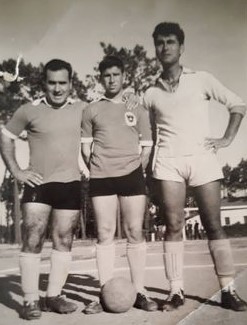
Paulo Anacleto is a nurse at Sobral Cid Hospital. His childhood memories are all connected to the staff housing estate of the Rovisco Pais Colony Hospital, where he lived until the age of 21.
His father, Manuel de Oliveira Anacleto, born in Mealhada in 1931, worked as a nurse at that hospital between 1956 and 1987. Paulo Anacleto explained that his father completed the first General Nursing Course, a three-year programme, at the Dr Ângelo da Fonseca School of Nursing in Coimbra, and afterwards “worked at the medical practice of Dr Santos, the ‘João Semana’ of Mealhada. The two of them travelled by bicycle throughout the whole municipality, and even to neighbouring areas such as Anadia, doing everything—including assisting with births. His great opportunity came while he was still single: moving to work at the Rovisco Pais Colony Hospital.”
Looking back, Nurse Paulo Anacleto admitted that “that coexistence, from the moment I was born until I left there, deeply marked who I am today.” He went on to describe the environment in which he grew up and shared some of his memories. “In the neighbourhood lived nurses, administrative staff, the priest, the hospital administrator, and doctors and nurses who had their home there. There was a strong sense of community and sharing—from conversation to salt or parsley.” And today he acknowledges: “We were privileged in the national context. Who had a telephone or running water at that time? And at affordable prices. We did—and the patients too!”
He remembers that the sisters from the Hospital’s Conventinho “would pass through the neighbourhood and take us by the hand to Mass and catechism in Tocha. It was two kilometres.” He also recalls the social gatherings: “I remember well the Christmas and Easter celebrations, including with the children of the patients who were in the Preventorium—we all played together! And the trips the Hospital organised to the farm they owned in Espariz, where staff and their children went using Hospital transport. It was wonderful social interaction. If there was a place where there was no class division, it was there, in the neighbourhood.”
Later, they began to socialize more closely with patients, as many of those who were discharged became neighbours. “My first dogs came from the home of Mr Cavaco and Mrs Leónia, who continued to live in the Hospital’s Family Units.” In Bairro do Camelo, near the neighbourhood where he lived, many hospital employees and former patients resided. One couple he knew well lived there: “Mr Professor Marques, a primary school teacher. After leaving the Hospital, he opened a small private room that functioned as an adult school, where he prepared people for the fourth-grade examination. My mother completed the fourth grade there when she was already around forty years old. He had been a patient, but people had no problem going to his school. And my first experience of watching television was in his house. I went with my mother and sister, crossing the pine forest with a flashlight, to watch the news on the television of Mr Professor Marques and his wife, Mrs Emília. People rebuilt their lives, and I think that is what matters most!”
He retains many memories of going to the Hospital hand in hand with his father. His father would say to him, “Don’t touch anything, don’t put your hands on the handrail.” He opened doors with his feet or elbows. Once, when he was about thirteen or fourteen, he went to the operating theatre: “those machines—we heard about them, but it was something new. It was almost like a child today going to a planetarium…”
And although after the 25th of April there were patients who moved about outside on bicycles—so children began to see them for the first time—going inside the Hospital was very different, as Nurse Paulo Anacleto recalled: “I remember it as if it were today; it left an indelible mark on me. My father took me to the ward and showed me a patient, only from the corridor, saying: ‘that one is blind, has no ears, no mouth, and had a tube; he was completely disfigured…’ Seeing them lying there, completely disfigured, with dreadful wounds—the smell was not what shocked me most; it was their appearance. There were very advanced cases in the Hospital. Many amputees, many wheelchairs. And I remember my father saying that he performed the first skin grafts.”
He also spoke about Dr Bissaya Barreto: “In the operating theatre, when he operated, there were only two nurses allowed in—Nurse Bernardes, and later my father.” There was also a story his father told him that he never forgot: “When Dr Bissaya Barreto came, he would do ward rounds with my father and a sister. One day he saw a sheet with a black stain and asked whether it had been sterilized. The sister said yes, and he replied: ‘Sister, would you also eat filth if it were sterilized?’ He demanded absolute rigour in matters of sterilization…”
Speaking of his father, Nurse Manuel de Oliveira Anacleto, he emphasized his selflessness, saying: “What marks me most was his total dedication. My mother remembers that when my father received his salary, he would put the money in his coat pocket and forget it there. It was a constant and total giving of what he knew to others. He lost track of time in the Hospital; he didn’t care about finishing hours. This happened every day. On Sundays he went to the Hospital to talk to the patients—we always knew where he was. While others went to the café, my father went to be with the patients. He often went to the Family Units where patients lived. He was not afraid of contagion and would lose himself in conversation. For him, that was everything. He embraced the whole mission fully and was happy talking with patients. And if anyone needed anything outside the Hospital, my father never charged a single escudo to anyone. Even when he was a masseur for União Desportiva da Tocha, he never wanted anything. He retired to Mealhada, was involved in hockey, and never took a cent. He had absolutely no interest in financial compensation. Just as in his profession.”
Nurse Paulo Anacleto continued, sharing: “My father retired at the age of 55. But he maintained permanent contact with patients—some would visit him in Mealhada or call him. And he would visit patients who were already living outside, travelling by bicycle.”